
A stable gas mixture starts with the gas supply itself.
What happens if a gas cylinder or cylinder bundle runs empty during production? With a mechanical gas mixer, the process may continue unnoticed – but with an incorrect mixing ratio.
We have already seen exactly this situation at customer sites. In one specific case, a process used a mixture of argon and 18% CO₂. When the CO₂ supply failed, the mechanical gas mixer continued operating. Experienced operators noticed that something had changed, but during ongoing production, the cause was not immediately identified. Only after analysing the gas mixture did it become clear that there was no CO₂ left in the mixture.
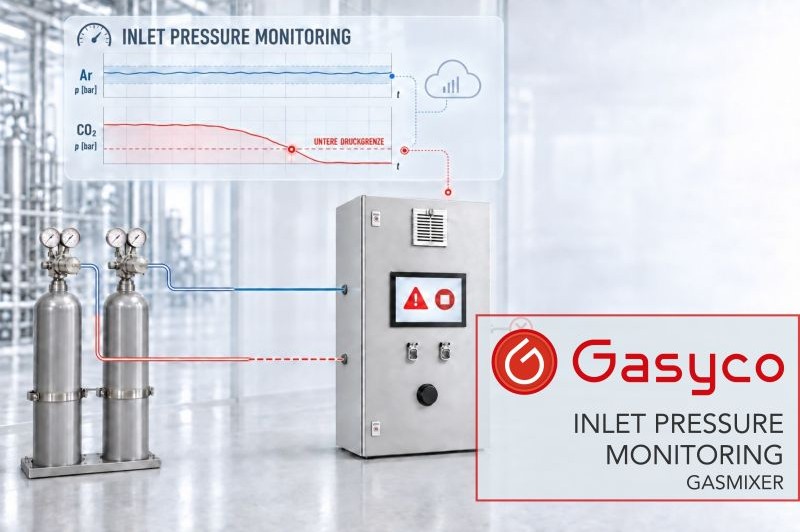
For this reason, every individual gas inlet on our digital gas mixers is monitored as standard. A dedicated pressure transmitter is installed upstream of each flow controller. The actual inlet pressure is displayed and recorded separately for every gas line and can also be visualised in the cloud dashboard.
If the supply pressure drops and the required flow rate can no longer be achieved, the desired mixing ratio can no longer be maintained reliably. The gas mixer detects this condition, stops the mixing process and triggers an alarm. This allows the gas supply to be checked or the empty cylinder or bundle to be replaced before production continues with an incorrect gas mixture.
The alarm limits can also be defined according to the requirements of the individual process. If the inlet pressure becomes unacceptably high, the solenoid valves additionally close to protect the components inside the system.
Inlet pressure monitoring is not an optional extra on our gas mixers and gas analysers – it is a standard part of the system. Because stable and reproducible gas mixtures require more than simply setting target values. The actual conditions at every individual gas inlet must also be monitored continuously.