
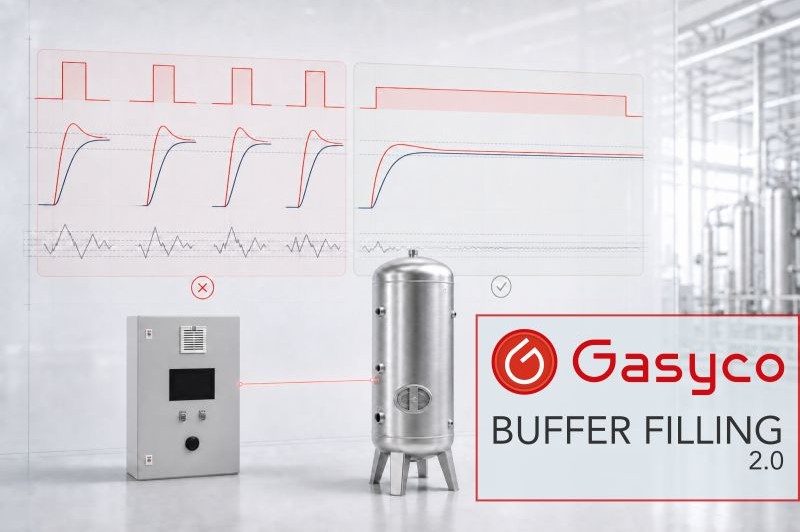
Why a high-precision gas mixer can still produce an inaccurate mixture.
The specified accuracy of a mass flow controller applies under steady-state conditions. After each start, the controller needs a short time to stabilize at its setpoint. During this startup phase, the gas flowing through the line does not yet meet the specified accuracy.
With conventional on/off control, this becomes a real problem: the mixer starts when the minimum pressure is reached, fills the buffer tank, and switches off at the maximum pressure. If the tank is only marginally sized for the actual demand, it may be full before the controllers have stabilized—and this happens again with every single cycle.
The result: expensive, high-precision controllers have been installed, yet the mixture in the tank never achieves the values stated in the datasheet.
A real-world example
A welding cell draws gas intermittently—weld, pause, weld. The buffer pressure drops in bursts, causing the mixer to switch on frequently and only for short periods. In a system with many short filling cycles, what you are really seeing is a high proportion of inaccurately mixed gas entering the tank.
This is particularly critical when retrofitting a system: a mechanical mixer has virtually no settling behavior. The existing tank was therefore designed under conditions in which short cycles were not an issue. If that same tank is later connected to an electronic mixer, precisely the situation described above arises.
Our new control algorithm
Instead of switching on and off between two fixed pressure thresholds, the control system monitors actual consumption and continuously adjusts mixture production to match it. Rising demand is reflected in falling tank pressure. The system detects this and compensates before a sharp refill cycle becomes necessary.
The benefits at a glance
- significantly fewer starts and flow-rate changes
- controllers operate continuously in their stable range for longer periods
- the startup phase accounts for a smaller proportion of the total filled volume
- the accuracy stated in the datasheet reaches the place where it matters: the buffer tank
The issue of short filling times is therefore not solved by making the tank larger, but by making startup phases less frequent.