In thermal and differential pressure instruments, mass flow is derived from something else. Heat transfer, or a pressure difference, is converted into mass flow using known gas properties. A Coriolis mass flow meter takes a different route:
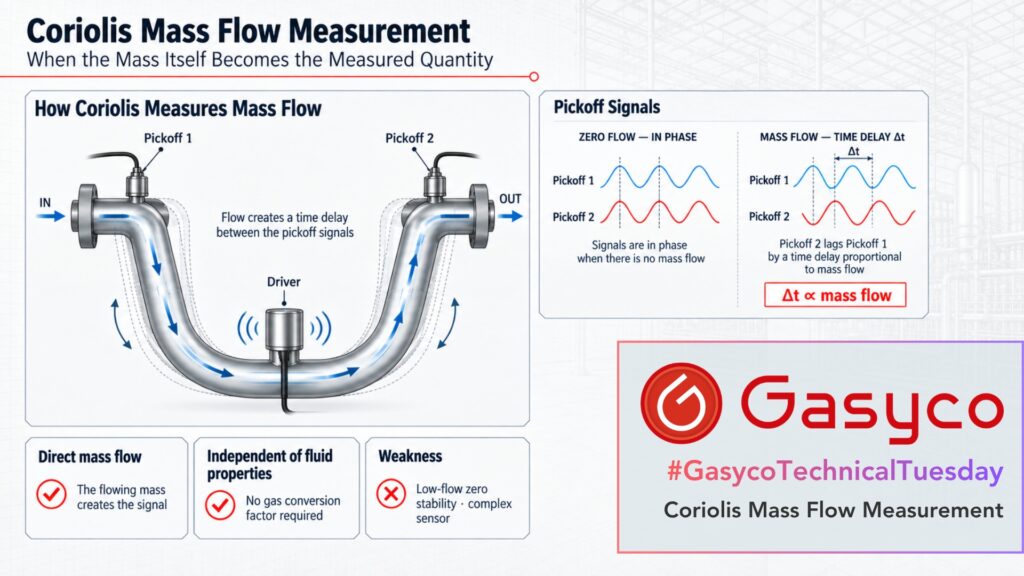
The flowing mass itself changes the vibration behaviour of a measuring tube.
Mass flow is therefore measured directly. For the mass measurement itself, no gas conversion factor and no calculation from pressure, temperature and density are required. That makes Coriolis particularly interesting where media change or compositions are not exactly known. ISO 10790 covers the method explicitly for mass flow and density measurement of gases, liquids and mixtures.
How the measuring signal is created
The heart of the instrument is a thin measuring tube, straight or bent depending on the design. A driver sets this tube vibrating close to its natural frequency, and two pickoff sensors record the movement at different positions along it.
At zero flow, both measuring points move essentially in step. Once mass flows through the vibrating tube, the medium has to follow the transverse movement of the tube while it is also moving forward. Because of its inertia, Coriolis forces appear, and the inlet and outlet sides are twisted slightly against each other.
The two sensor signals therefore no longer arrive at the same moment:
The greater the mass flow, the greater the time delay between them.
It is worth being precise here. What is evaluated is the time delay between the two pickoff signals, and that delay is directly proportional to mass flow. Phase shift only tracks mass flow at a constant drive frequency, and the drive frequency is not constant: it moves with the density of the medium, as the next section shows.
The scale is worth appreciating. That time delay is in the range of microseconds. The entire measurement rests on cleanly resolving a difference of a few millionths of a second.
Why this counts as direct mass measurement
In a volumetric measurement, the mass being transported depends on density. With gases that matters enormously, since the same volume contains far more mass at higher pressure. Volumetric methods therefore have to know the density, or determine it from pressure, temperature and gas data, before a mass flow can be stated.
With the Coriolis principle, the tube responds directly to the mass passing through it. Pressure, temperature or gas type may change the volume drastically. Mass remains the primary measured quantity.
This does not mean a Coriolis meter is free of process influences. Tube stiffness changes with temperature, which is why the tube temperature is measured and compensated, and process pressure stiffens the tube slightly as well, so pressure compensation is common in high-pressure gas service. Pipe stress, external vibration and multiphase flow all have an effect too.
The difference is a different one: gas properties are not needed to turn the primary signal into a mass flow in the first place.
Independent of the flow profile
Because the entire mass passing through the tube acts on it, rather than a local velocity being sampled at one point, a Coriolis meter is largely indifferent to the velocity profile. In practice that means no straight inlet and outlet runs are required.
Readers of the earlier parts of this series will recognise the contrast. With an orifice plate, a Venturi or a Pitot tube, inlet conditions and flow profile are central, and installing them properly costs pipe length. In cramped plant layouts, removing that constraint is often the argument that decides the selection.
Tube geometries and additional measured values
Dual-tube systems can be balanced mechanically against each other, which makes them less sensitive to external vibration. Bent tubes give a longer effective measuring section and therefore higher sensitivity, at the price of higher pressure drop and poorer drainability. Straight-tube systems offer a simple flow path, lower pressure drop and easier cleaning, but are less sensitive and react more strongly to mounting stress.
The resonant frequency also depends on the total mass of the vibrating system. If the density of the medium changes, so does the natural frequency, and the transmitter can derive density from it. Together with the mass flow this gives:
volume flow = mass flow / density
For liquids, that density measurement is often a valuable additional process value. For gases it is far more demanding, because their low density shifts the resonant frequency much less.
Why very small gas flows become difficult
With very small gas flows the signal becomes weak, simply because very little mass is moving through the tube.
Zero stability then becomes the limiting factor. Even at zero flow, a real sensor shows a small scatter around zero, and ISO 10790 defines zero stability as a performance parameter in its own right. At high flow rates this residual error is negligible. At small flow rates it can make up a substantial share of the reading:
same zero error plus smaller flow means larger relative uncertainty
A second effect pulls in the same direction. Because gas density is low, reaching a mass flow large enough to produce a strong signal requires high velocity, and high velocity through a thin tube costs pressure. This is why thermal and LFE-based mass flow controllers usually remain the more economical choice for small, clean and known gas flows.
Strengths
- direct measurement of mass flow, with no gas conversion factors required
- largely independent of gas type and composition
- suitable for both gases and liquids
- no straight inlet or outlet runs required
- no bearings, seals or rotating parts in the flow path
- additional process values such as density and temperature
Weaknesses
- more complex and usually more expensive sensor construction
- zero stability limits the usable range, especially at very small gas flows
- thin measuring tubes can cause a relevant pressure drop
- external vibration and mechanical pipe stress can influence the measurement
- deposits change the vibrating mass, shifting the zero point and corrupting the density reading
- abrasive media can erode the thin tube wall
- multiphase flow can change the vibration behaviour considerably
External vibration deserves particular attention, because the useful signal is itself a very small mechanical effect. Modern tube designs and signal processing reduce the influence substantially, but sound mechanical installation remains important.
Why Coriolis is interesting for safety-related measurement
In safety instrumented systems according to IEC 61508 and IEC 61511, Coriolis becomes interesting whenever the actual mass flow is itself a safety-relevant process variable.
The advantage is not that the principle automatically reaches SIL 2 or SIL 3. A safety integrity level always applies to a specific safety function and its complete chain, from sensor to final element. What Coriolis does is remove dependencies: for the mass measurement, neither the exact gas composition nor a conversion factor nor an additional pressure and temperature compensation has to be correctly configured. Fewer parameters that can be set wrong means fewer systematic failure paths. Modern instruments add extensive self-diagnostics, and certified versions are available that are suitable for use in SIL 2 in single-channel architectures and SIL 3 in redundant ones.
Mass flow meter or mass flow controller?
Unlike thermal instruments, Coriolis is used in industry predominantly as a mass flow meter. It delivers the mass flow to a process control system, while a separate control valve, or a pump in liquid service, sets the flow.
Integrated Coriolis mass flow controllers do exist, combining sensor, electronics, controller and control valve in one device. They are mainly available in the low-flow range and remain a comparatively specialised application next to classic Coriolis meters.
Where Coriolis stands against thermal and differential pressure
This series has now covered four measuring principles, and a pattern has run through all of them. Every one depends on a different property of the gas.
Thermal instruments depend on heat capacity. Laminar flow elements depend on viscosity. Orifice plates and Venturis depend on density. Critical nozzles depend on the ratio of specific heats and the gas constant.
Coriolis is the first principle in this series that breaks the pattern. For the mass measurement itself, it needs none of them.
Conclusion
Heat transfer, pressure drop and flow velocity all have to be converted into mass. Here, the flowing mass generates the measuring signal itself.
That makes the method notably robust against changing fluid properties and explains its standing in demanding and safety-related mass flow measurement. Against it stand a more complex sensor design, higher cost, and the growing weight of zero stability at very small gas flows.
Where direct mass measurement, medium flexibility and high measurement integrity matter more than minimum cost and size, Coriolis remains one of the most capable technologies available.