Thermal, differential pressure and Coriolis instruments all determine flow from something else: heat transfer, a pressure relationship, or the inertia of a moving mass. A gear flow meter takes a far more direct route:
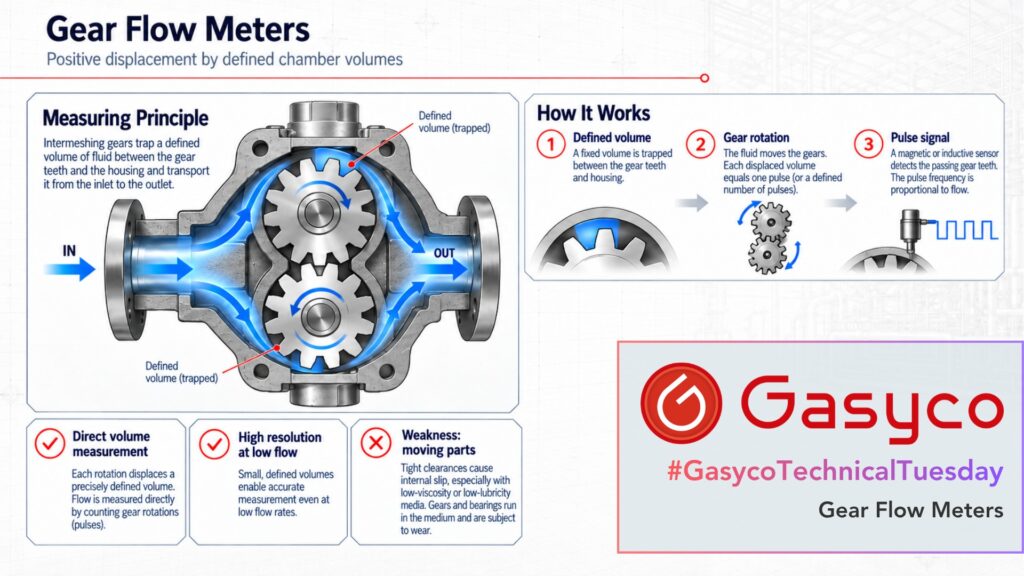
It carries the medium through its measuring chamber in defined portions and counts how often that portion is displaced.
This makes it a positive displacement meter. Unlike a Coriolis instrument it does not measure mass, it measures volume, and its strengths lie with liquids: small flows, viscous media and precise dosing.
One note on scope. We build gas mixing and gas analysis systems, and we have never used a gear flow meter in one. This series set out to cover flow measurement properly, which means covering the principles outside our own field alongside those inside it.
How does a gear flow meter work?
The measuring element consists of two precisely meshing gears inside a tightly toleranced housing.
When liquid enters, the pressure difference between inlet and outlet sets the gear pair rotating. Small, geometrically defined volumes are trapped between the gear teeth and the housing wall and carried from inlet to outlet. Where the gears mesh, direct passage is largely blocked. Every rotation moves a known partial volume onward:
more revolutions per unit of time means higher volumetric flow
The method does not measure the velocity of the medium. It repeatedly counts known volumes, and that is what separates positive displacement instruments from most other flow technologies.
From gear movement to an electrical signal
The rotation is detected without contact. A magnetic or other electronic pick-up registers the passing teeth and generates pulses:
- Number of pulses: corresponds to the total volume passed
- Pulse frequency: corresponds to the current volumetric flow
The relationship is described by a K-factor, for example in pulses per litre. Several thousand pulses per litre is common, and modern electronics interpolate between teeth to reach considerably higher resolution again.
The K-factor is often quoted as though it were a fixed device constant. It is not. It varies with flow rate and viscosity, for reasons the next section explains. Manufacturers therefore supply linearisation curves or multi-point calibrations rather than a single number, and a meter calibrated on one liquid cannot simply be moved to another.
Why does viscosity matter so much?
An ideal displacement meter would carry exactly the same volume with every revolution. A real one needs small clearances between gears, housing and bearings, and part of the liquid flows through them, past the actual measuring volume. This is called internal leakage, or slip.
With low-viscosity liquids the medium passes through the clearances more easily, and at small flow rates combined with a high pressure difference, that share becomes significant relative to the volume actually measured. Meters built for low-viscosity media therefore use particularly tight clearances to suppress it.
As viscosity rises, internal slip usually falls, which is why gear meters suit oils, resins and paints so well. But higher viscosity has a downside:
less slip, more resistance in the measuring element
Higher viscosity increases the torque required to turn the gears, and with it the pressure drop across the meter. Viscosity is therefore neither an advantage nor a disadvantage in itself. It is a central design parameter.
Why temperature belongs in the same discussion
This is where the practical difficulties usually begin, and it follows directly from the previous section.
The viscosity of a liquid is strongly temperature dependent. With oils, a change of ten kelvin can nearly halve it. Since slip depends on viscosity and the K-factor depends on slip, the calibration of a gear meter is effectively temperature dependent too. A meter calibrated at 20 °C and operated at 50 °C will not read the same. Thermal expansion of housing and gears adds a second, smaller effect on the volume displaced per revolution.
This is not an obscure detail. OIML R 117-1, the international recommendation for dynamic measuring systems for liquids other than water, requires accuracy testing at the limits of temperature, pressure, viscosity and density. Those four quantities are the operating envelope of a displacement meter, and they appear on its data sheet as ranges, not single values.
Why does the principle work so well at small flows?
Many methods derive flow from velocity or pressure, so as the flow becomes very small, so does the signal.
With a gear meter the defined partial volume remains what it is. As long as the liquid produces enough torque to overcome friction and bearing resistance, every tooth movement delivers a clearly detectable event. That allows repeatability around ±0.05 percent of reading for good instruments, with usable spans of roughly 10:1 to 100:1 depending on viscosity.
At the very bottom of the range the advantage reverses. Friction and internal leakage gain relative weight, and the minimum flow depends strongly on viscosity, pressure difference, gear geometry and bearing design.
Strengths and limits
The main strengths are direct volumetric measurement, high resolution and repeatability, and suitability for small and viscous liquid flows. Bidirectional measurement is possible with appropriate sensing, and high-pressure versions are available.
One more is easy to overlook: the sensor does not evaluate a velocity profile. Where a Venturi, vortex, turbine or ultrasonic instrument is affected by disturbances immediately upstream, a gear meter registers displaced volume, so long settling sections are typically not required. In compact machines, where pipe length is expensive, that matters.
The precision mechanics are at the same time the greatest limitation. Gears and bearings move directly in the medium. Particles can damage or block the tight clearances, wear affects the element over time, and at high viscosities the pressure drop rises considerably. Adapted materials, bearings and clearances do make poorly lubricating or abrasive media measurable.
Two further limits. The tooth engagement produces a systematic volume and pressure pulsation, which matters in dosing and downstream pipework. And gas bubbles are a genuine problem: the sensor counts displaced volume and cannot tell whether a chamber held liquid or partly gas.
Why are classic gear meters rarely used for gases?
Here the technology differs sharply from thermal, differential pressure and Coriolis instruments. Precision gear meters are built for pumpable liquids: fuels, oils, paints, resins.
Three things work against gases. Their very low viscosity lets them escape through the necessary clearances almost unhindered, so slip overwhelms the measured volume. Their compressibility makes the trapped volume dependent on local pressure and temperature. And gases do not lubricate, which is serious for a mechanism built around the tightest possible clearances between moving metal parts.
That does not mean the displacement principle fails with gases. Roots and rotary gas meters also use defined volume chambers, but their rotor and housing geometry is designed for compressible, non-lubricating media. A precision gear flow meter is not the same thing as a gas displacement meter.
Volume flow or mass flow?
The gear meter measures volumetric flow Q directly. To obtain mass flow, mass flow = density × Q, so the density has to be known or measured separately. With liquids that is often manageable. But where temperature, composition or density change significantly and the actual mass is what matters, Coriolis holds a clear advantage, because there the mass flow is measured directly.
- Gear meter: direct volume measurement
- Coriolis: direct mass measurement
Meter or controller?
Gear technology is used predominantly as a flow meter. For a control task the signal goes to a controller driving a valve or a dosing pump. With viscous liquids, gear meter plus controller plus speed-controlled pump is often the sensible combination: the pump generates the flow and actuates at the same time.
Where the gear meter sits in this series
Something elegant emerges next to the second article in this series.
The laminar flow element and the gear meter depend on the same fluid property: viscosity, but in opposite directions. The LFE uses viscous friction as its measuring effect, so higher viscosity means a stronger signal. The gear meter fights viscosity-dependent leakage, so higher viscosity means less error.
Two technologies that could hardly be more different mechanically, governed by the same quantity with opposite signs. A good illustration of why “which flow meter is best” is never a useful question on its own.
Bonus: other displacement principles
Not every displacement meter uses spur gears.
Oval gear meters also trap defined volumes between rotors and housing, but only a few large ones per revolution rather than many small ones. That gives lower resolution and at the same time makes them less sensitive to particles. Screw spindle meters carry the medium axially with meshing helical rotors, producing a smoother, low-pulsation flow.
The common principle remains: a defined partial volume, captured mechanically and counted repeatedly.
Conclusion
Instead of inferring flow from temperature, pressure or velocity, the measuring element carries defined partial volumes and counts their movement. That enables high resolution, very good repeatability and measurement of very small liquid flows.
The precision mechanics are at the same time its most important constraint: viscosity, temperature, internal leakage, contamination, bearing friction and pressure drop all have to suit the application.
Unlike thermal, differential pressure and Coriolis instruments, the classic gear principle is above all one thing: a high-precision technology for liquids.